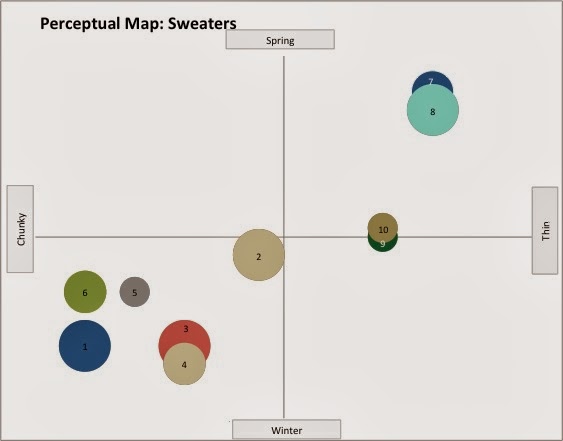
Wednesday, February 5, 2014
Closet Update: Sweaters
Wednesday, March 6, 2013
Closet Confessions: Denim
Yesterday was mortifying cathartic. It's pretty clear to all of us that I have a problem with denim. On a positive note, we can celebrate the fact that there are no jeggings in that collection. Yes, I consider that to be a win.
So let's delve a little deeper, shall we? One of the first things I do when I get a new data set is to check for duplicates and the same rules apply when tackling my wardrobe. For example, the dark skinny jeans that I never wear because I like my other pair better. Then there was the low-hanging fruit, the pair of jeans I've owned since 2006 but only worn once (yeah, that should have gone along time ago). Duplicates Found. Three pairs in the donate pile. Done.

Friday, March 1, 2013
State of the Closet
If I was a cleverer more experienced blogger, I would have timed this post to coincide with the POTUS's State of the Union (get it, State of the Closet . . . State of the Union. Don't judge me too harshly. I've lived in DC waaaay to long). But, moving on.
It turns out that one person can accumulate a lot, (I mean a massive amount) of clothes that they don't wear/know about over a 27-year life span. I won't pretend that I have finished logging everything I own. For starters about a third of my wardrobe is in storage. It's mostly summer things, but that probably should have been the first indication I have too many clothes.
So far, I've collected data on 58 items and that's probably (rough guess) about half of what I currently have in my closet, excluding shoes, pajamas, things like belts, and *ahem* delicates. Since the criteria for my "model" closet is that it meets my needs for a professional wardrobe, I decided to start with my work clothes and go from there. While I don't have enough to draw any real conclusions, I am seeing some interesting things:
- I have waaaaaay more bottoms than tops. So far I've counted about 9 pairs of pants and 14 skirts and only have 11 blouses logged. Granted I haven't finished listing all my tops, but right now that's more than double the amount of bottoms to tops.
- I don't need to buy new jeans anytime soon. Right now I have 10 pairs. But, when I think about it, I only really wear 4 or 5 of them on a regular basis. And, most of the time, I live in one of my two pairs of AG jeans.
- On that note, I could probably lay off stocking up on work dresses. Right now I have 7 that are purely for work and I'm guessing I have a lot more in my summer storage box.
Monday, February 18, 2013
(Data) Models
The first time I heard of "modeling" outside of the context of fashion models was in a college math class. (Does it surprise you that I was a math minor?) In order to satisfy my degree requirements, I had to take an elective called "Mathematical Modeling". The class was pretty theoretical and since I had a severe case of senioritis, I didn't absorb much. Luckily (?) for me, that wasn't the last time I came across the idea of models. In the data world, modeling is usually talked about in the context of building databases or enterprise-wide systems. Basically it's the concept that you need to build a blueprint of what you want your "perfect" system to look like to use as a guide when building out your system. You can also use it as a way to measure the performance of your existing systems.**
Now, I'm not building a database but some of the same principles apply. If my list of questions are the road map, the "model closet" is the destination. I know, I know I made fun of those lists that claim to be the ten or twenty essential things you need for your closet, but, in theory, they kind of have the right idea--they offer a blueprint to follow in putting together a functional wardrobe. The problem is they aren't customized for me, or you, or anyone's (woman, man, merman, what have you) real, individual lives and needs.
So what would my "model closet" look like? One that's customized for my unique preferences and needs? At this point I still only have a hazy idea, but I do know some of the basic criteria my ideal closet would have to follow.
- Most of my life is spent inside an office cubicle, so as much as I love casual wear, the majority of my wardrobe should be for my 9-5 job. On the simplest level, I need to be able to put together at least 20 professional outfits a month (5 outfits a week x 4 weeks)
- I need to be able to transition through four, distinct seasons (maybe that means a lot of layering pieces, I'm not sure)
- In order to get the most value out of my closet, I should probably have 2-3 tops for each bottom (skirt or pants). That's not a scientific number, but it's a personal rule-of-thumb I apply while shopping.
**I am by no means an expert in data modeling. If you're curious about it, this post is an excellent starting point.
Tuesday, February 12, 2013
Planning: Data Journeys (Continued)
|
Type
|
Style/Cut
|
Color
|
Purpose
|
Season
|
Rating
|
Brand/Store
|
|
Pants
Jeans
Shorts
|
Cropped/Ankle
Boot cut
Straight-leg
Skinny
Trouser/Wide-leg
|
Beige
Black
Blue
Brown
Green
Gray
Metallic
Off-White
Orange
Pink
Purple
Red
White
Yellow
Multi
|
Work
Play
Work & Play
Dress-Up
|
Spring
Summer
Fall
Winter
|
Hate it
Meh
Like it, Don’t Love it
Wardrobe Staple
Feel Like a Million Bucks
|
AG
American Apparel
Ann Taylor/Ann Taylor Loft
Anthropologie
Banana Republic
Club Monaco
Everlane
Express
Gap
H&M
J. Crew
Madewell
Nordstrom
Old Navy
Paige
Urban Outfitters
Zara
Other
|
|
Skirt
Dress
|
A-line
Pencil
Mini
Maxi
|
|||||
|
Blouse
T-Shirt
Sweater
|
Cardigan
Collared Button-Up
Long-Sleeve
Short-Sleeve
Sleeveless/Tank Top
Tunic
|
|||||
|
Blazer
Coat
|
|
Not going to lie, my inner data-nerd is pretty excited by this table. Probably more than is healthy. Now, I’m going to remind myself I actually socialize with people and don’t just talk to myself on the internet all day.
Sunday, February 10, 2013
Planning: Data Journeys
- Item Type and Style
- Purpose
- Season
- Color
- Store/Brand
- Rating--How did it make me feel?
Wednesday, February 6, 2013
Planning: Building a Roadmap
As anyone who has done any work in evaluations or data analysis knows, the first step in designing a project is figuring out what questions you want to answer. Those questions become the guiding post for determining what data you need to collect. Else you can end up with a lot of interesting "facts" or "trends" but no usable information.
- What do I actually own?
- What do I actually wear and what do I love wearing? (conversely, what can I get rid of?)
- Given my lifestyle (9-5 job, active, big social circle), what do I need to buy to make my wardrobe more functional?
- What is my personal style? (not sure if this is a question data can answer for me, but we'll see!)
- Once I have all the basic pieces, what should I be buying to make my wardrobe more me?
- Do I own a lot of any specific color?
- How much do I normally spend on clothes?
- Are the things I spend more on, things I wear more often?
- What brands do I buy from the most?
- Ummm, what should I wear on Monday?
Monday, February 4, 2013
A Data Nerd's Approach to Fashion
For years, I've bought things because they were on-sale or a "good deal" or on impulse or out of desperation (i'm glaring at you pantyhose). Please tell me I'm not the first person who's gone on a shopping binge and ended up with a ton of stuff I didn't need and somehow still didn't own a white button up shirt? And that I'm not the only woman who stands in front of a closet overflowing with clothes but often feels she has nothing to wear? But, it's a new year and I'm on a mission to revamp my wardrobe, figure out what my personal style is, and hopefully be a smarter shopper.
I've tried using those "ten essential items" lists or "20 things every woman should own". While helpful, those lists feel incomplete. First of all, what exactly do I own? Secondly, what do I do with the wardrobe I have (which includes waaaaay more than ten items) and what do I need to buy (or throw out) to make it better? Plus, what do I need aside from those first ten items to express my own, personal style?
I know . . . deep, deep questions. Anyway, I had a lightbulb moment a few weeks ago. In my normal life, not rambling on the internet, I analyze data. (I know this is the moment you see me as a scary cat lady with spectacles and zero social skills. Don't worry that's a false stereotype. Though I do wear glasses) And, I started to think, if I can take a company's financial or personnel records and use them to tell them where they need to hire or cutback, why couldn't I use data, my own data, to be a better shopper? Thus starts the nerdiest fashion project in the history of the world.